
If you’re wondering how to get more therapy clients, here’s the honest version nobody selling you something will give you: there are only six channels that actually work. Referrals, directories like Psychology Today, insurance panels, Google Ads, social media, and SEO. That’s the whole list. Everything else (networking breakfasts, podcast guesting, flyers at the coffee shop) is a flavor of one of those six.
I’m Patrick Antinozzi. I’ve spent 13 years running RapidWebLaunch and I now run The Therapist SEO Company. Yes, I sell one of these six channels, and I’ll tell you exactly where SEO fits and where it doesn’t. But first I’m going to walk through every channel with real cost math, because the right answer depends on your caseload, your market, and how fast you need clients.
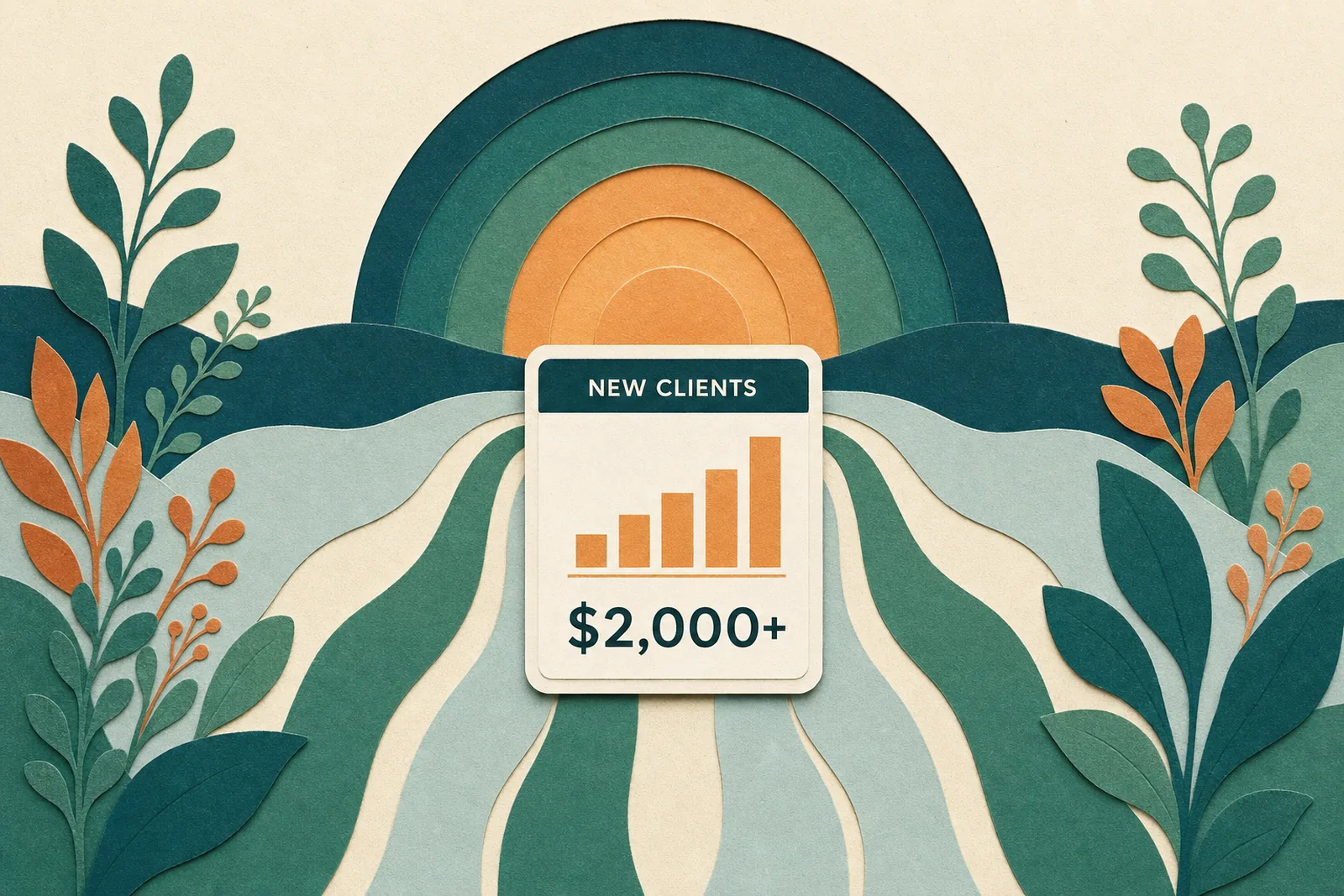
One number to hold onto the whole way through: a new therapy client is worth roughly $2,000 or more in lifetime value. At about $150 per session over 15 or more sessions, that’s the payoff every channel is competing to deliver. Judge each one against that number, not against how it feels.
The six real channels at a glance
| Channel | Typical cost | Speed to first client | Cost per client trend | You own it? |
|---|---|---|---|---|
| Referrals | Time, mostly free | Slow to build | Low but capped | Partly |
| Psychology Today and directories | $30 to $100/mo | Days to weeks | Flat | No |
| Insurance panels | Reduced session rates | Weeks to months | Hidden in your rate | No |
| Google Ads | $500 to $2,000+/mo | Days | Flat or rising | No |
| Social media | Time, 5 to 10 hrs/mo | Months, unreliable | Unpredictable | No |
| SEO + your website | $0 to $1,500/mo | 4 to 6 months | Falls over time | Yes |
Now the detail, channel by channel.
Referrals: the best clients, the worst growth plan
Referrals from physicians, psychiatrists, school counselors, attorneys, and other therapists are the highest-quality channel there is. A referred client arrives pre-sold, shows up, and stays. If you run a specialty practice (EMDR, couples work, eating disorders), a handful of strong referral relationships can keep a solo caseload full.
The math: the cost is your time. A few hours a month of lunches, letters, and follow-up. Against a $2,000+ client value, that’s an outstanding return per client.
The problem is scale. Referrals are a function of relationships, and relationships don’t scale on demand. When a referring psychiatrist retires or a group practice hires their own in-house counselor, your pipeline drops overnight and there’s no dial to turn. Referrals also can’t fill a new clinician’s caseload in a group practice on any predictable timeline.
When referrals make sense: always. Build them forever. Just don’t call them a growth strategy. They’re a foundation, and every practice I’ve seen that relies on referrals alone eventually hits a plateau it can’t think its way past.
One ethics note while we’re here: referral relationships with professionals are fair game. Soliciting reviews or testimonials from current clients is not. APA, ACA, and NASW ethics codes all restrict it, and it’s a fast way to turn a marketing tactic into a licensing board conversation. Your reputation strategy has to be built on compliant signals: professional referrals, your credentials, and content that shows expertise.
Psychology Today and directories: cheap, easy, and commoditized
Psychology Today, TherapyDen, GoodTherapy, Zencare, Open Path. For roughly $30 to $100 a month, you get a profile in front of people actively looking for a therapist.
The math is genuinely good at the low end. Psychology Today runs about $30 a month, or roughly $360 a year. One client from the directory per year and you’ve made five times your money. Most therapists in reasonably sized markets get more than one, which is why almost everyone should have a listing.
Here’s what the directory doesn’t tell you. You are one card in a wall of dozens. The searcher filters by insurance, specialty, and price, and every profile looks structurally identical, so you compete on your photo and your first two sentences. You can’t rank higher through better work; you can only pay for promoted placement. And the directory owns the relationship: the searcher remembers “I found her on Psychology Today,” not your practice name.
There’s a bigger structural issue. Directories rank in Google for the exact searches you want to rank for. Every month you rely on them, you’re helping the middleman outrank you for “therapist in [your city].”
When directories make sense: every new practice, day one. Cheap, fast, zero skill required. Just treat the listing as a supplement while you build something you own, not as the plan.

Insurance panels: volume with a haircut
Getting credentialed on insurance panels (Aetna, BCBS, Cigna, UnitedHealthcare, Medicaid in many states) is the highest-volume channel on this list. Panels feed you clients through their own directories and referral lines, and for many help-seekers “takes my insurance” is the first and only filter.
The math hides in your rate. Panels don’t charge a marketing fee; they take it out of every session. If your private-pay rate is $150 and the contracted rate is $90 to $110, you’re paying $40 to $60 per session for the client flow. Over a 15-session course of care, that’s $600 to $900 per client. It’s the most expensive channel on this list per client; it just doesn’t feel like it because you never write a check.
The upside: volume and predictability. A new clinician in a group practice can fill a caseload in weeks on the right panels. For practices in lower-income markets, panels aren’t optional; they’re the market.
The downside: you’re trading margin for volume, credentialing takes weeks to months, and you have zero control. A panel can change rates, tighten authorizations, or go narrow-network, and your pipeline changes with it.
When panels make sense: group practices staffing up, new practices that need volume now, and any market where private pay is a minority of demand. The mistake is stopping there. The practices with the healthiest margins use panels for baseline volume and build private-pay flow through search, which is where the next three channels come in.
Google Ads: fast, real, and expensive forever
Google Ads puts you at the top of the search results for “therapist near me” or “anxiety therapist [city]” this week. It’s the fastest way to generate inquiries from strangers, full stop.
The math, honestly. Benchmarks from WordStream and LocalIQ have consistently put counseling and therapy-adjacent keywords among the pricier local categories, commonly $5 to $15 or more per click in US metros. Walk through a realistic funnel:
- $10 average cost per click
- 10% of clicks become an inquiry: $100 per inquiry
- Half of inquiries become booked clients: $200 to $600 per client depending on your market and landing page
Against $2,000+ in lifetime value, that can absolutely be profitable. I want to be fair here: Google Ads is a legitimate channel, and for a practice that needs clients in the next 30 days it’s often the right call.
The two catches. First, the meter never stops. Your 100th client costs the same as your first, and in most metros click prices drift up, not down. Spend $1,000 a month for three years and you’ve spent $36,000 renting a position you’ll never own. Second, ads take skill. Broad-match keywords, no negative keyword list, and a homepage as your landing page will quietly double or triple your cost per client. Most therapists running their own ads are overpaying and don’t know it.
When ads make sense: launching in a new market, filling a new clinician fast, or bridging the 4-to-6-month gap while SEO takes hold. As a permanent primary channel, the math almost always loses to ranking organically for the same searches.
Social media: presence, not pipeline
Instagram, TikTok, Facebook, LinkedIn. This is the channel therapists feel the most pressure about and the one that reliably delivers the least.
The core problem is intent. Nobody opens Instagram looking for a therapist. They’re scrolling. Your reel about anxiety might reach thousands of people, and almost none of them are in your city, ready to book, and a fit for your practice. Compare that with someone typing “trauma therapist bismarck” into Google. One of those people is a probable client; the other is an audience member.
The math: the cost is time, and the time is real. Doing social media “properly” is 5 to 10 hours a month minimum. At your session rate, that’s $750 to $1,500 a month of your time for a channel with unpredictable, often zero, local client flow. A tiny number of therapists turn large followings into courses and books. That’s a media business, not a practice-growth channel.
What social is actually for: proof. When a referred or Google-found prospect checks you out before booking, an active, warm profile confirms you’re real and current. That’s worth an hour a month. It is not worth ten.
When social makes sense: as a light credibility layer, or if you genuinely enjoy it. If it feels like a second job, you have my permission to quit. The clients you’re afraid of missing there were mostly never there.
SEO and your own website: the only channel that compounds
Now the one I sell, so read this knowing that, and check the logic yourself.
SEO means your own website ranking in Google for the searches people in your city make when they’re ready to book: “therapist near me,” “couples counseling [city],” “emdr therapy [city].” Google’s own research and industry studies have long put local intent at close to half of all searches, and therapy is a local, high-intent category. These searchers are the same people clicking directory listings and ads; SEO just puts your site in front of them instead of a middleman’s.
Why the math is different from every other channel. Ads, directories, and panels all charge you the same toll for every client, forever. Rankings work the other way. The work you pay for in month three is still producing clients in month thirty. Say professional SEO runs $1,500 a month (that’s our flat rate, and it’s the only plan we sell, month to month, no setup fees, no contracts). If it produces three clients a month once rankings mature, that’s $500 per client and falling, because the same rankings keep producing while the cost stays flat. Stop paying for ads and your inquiries stop that afternoon. Stop paying for SEO and your rankings keep working; they just stop improving.
The honest downsides. SEO is slow: plan on 4 to 6 months before rankings move meaningfully, which is exactly why ads exist as a bridge. It requires a real website, not a directory profile or a page-builder placeholder (that’s the web design side of the work). And in a market with very little search volume, there’s little to capture; you can check what people in your area actually search with our free therapy keywords tool.
Proof instead of promises. Our client Dakota Trauma Therapy in Bismarck, ND ranks #1 for “bismarck therapists” and holds 21 local searches in the top 10. Every one of those rankings produces inquiries without a per-click fee attached. The full numbers are in the Dakota Trauma Therapy case study.
When SEO makes sense: any practice that plans to exist in three years, in any market where people search for therapy. Which is nearly all of them.

The cost-per-client scoreboard
Pulling the math together in one place:
| Channel | Realistic cost per client | What happens when you stop paying |
|---|---|---|
| Referrals | Near zero, capped volume | Relationships fade slowly |
| Directories | $30 to $150 | Listing disappears, inquiries stop |
| Insurance panels | $600 to $900 (in rate discounts) | Client flow stops |
| Google Ads | $200 to $600 | Inquiries stop same day |
| Social media | Unpredictable, often very high in time | Reach decays in weeks |
| SEO | High at first, falls toward $300 to $500 and below | Rankings persist for months to years |
Two things jump out. Insurance panels, the channel that feels free, is often the most expensive per client. And SEO is the only line where the number moves in your favor over time.
How to stack the channels by practice stage
You don’t pick one channel. You sequence them.
Brand new practice, empty caseload: Psychology Today listing on day one. Panels if your market demands them. Google Ads if you can spend $500 to $1,000 a month for fast flow. Start SEO now, because the 4-to-6-month clock only starts when you do.
Established solo practice, wants steadier flow and more private pay: you likely have referrals and a directory listing already. The gap is search. Get the website and rankings in place, then let ads and low-margin panel work taper as organic inquiries replace them. This is the exact situation our therapist SEO service is built for, and why we only take one practice per service area.
Group practice, hiring clinicians: you need volume on a schedule, which means panels plus ads for speed and SEO for margin. Every clinician you fill from your own rankings instead of a panel is roughly $600 to $900 more margin per client episode. Across a group, that’s the difference between a stressed practice and a profitable one. If you’d rather see it as a system than a channel list, that’s our lead generation service in one sentence: your site, your rankings, your inquiries, on one flat plan.
Full caseload with a waitlist: congratulations, stop reading marketing articles. But keep the website strong anyway; it’s what lets you raise rates, launch a group, or hire an associate on your own timeline instead of a panel’s.
The one-sentence answer
How to get more therapy clients: keep building referrals, use directories and ads as rented bridges, take panels with your eyes open about the real cost, skip the social media treadmill, and put your long-term money into the only asset that compounds, which is your own website ranking for the searches your future clients are already making.
If you want to see where your own site stands, run our free Practice Visibility Report. It takes about a minute, checks the things that decide whether people in your city find you, and gives you a fix list in plain English. No pitch deck, no pressure.
Frequently asked questions
- What is the fastest way to get more therapy clients?
- Google Ads and directory listings like Psychology Today are the fastest, because they put you in front of people already searching for a therapist this week. Ads can produce inquiries within days. The tradeoff is cost: both channels stop the moment you stop paying, so they work best as a bridge while you build channels you own.
- Is Psychology Today worth it for getting therapy clients?
- Usually yes, especially early on. At around $30 per month, one client from the directory in an entire year pays for the listing many times over. The catch is that you are one profile among dozens in your city, filters commoditize you, and the directory keeps the relationship with the searcher. Treat it as a supplement, not a strategy.
- How much does it cost to get a new therapy client with Google Ads?
- Therapy and counseling keywords commonly cost $5 to $15 or more per click in US metros, based on benchmarks from platforms like WordStream and LocalIQ. If 1 in 10 clicks becomes an inquiry and half of inquiries book, a new client can cost $200 to $600. That can still be profitable against $2,000+ in lifetime value, but only with a good landing page and tight targeting.
- Does SEO really work for therapists in private practice?
- Yes, when the market has search volume and the work is done properly. Roughly half of Google searches have local intent, and someone typing 'therapist near me' is ready to book. Our client Dakota Trauma Therapy ranks #1 for 'bismarck therapists' with 21 local searches in the top 10, and those rankings keep producing inquiries month after month without a per-click fee.
Read more

Couples Counseling Marketing: Fill Your Caseload in 2026
Couples counseling marketing that works: the keywords couples actually search, the two-decision-maker dynamic, premarital niches, and Gottman/EFT signals.
When Do People Look for Therapists? The January Surge
When do people look for therapists? January, September, and post-holiday spikes explained, plus how to time your SEO so you rank before the wave hits.