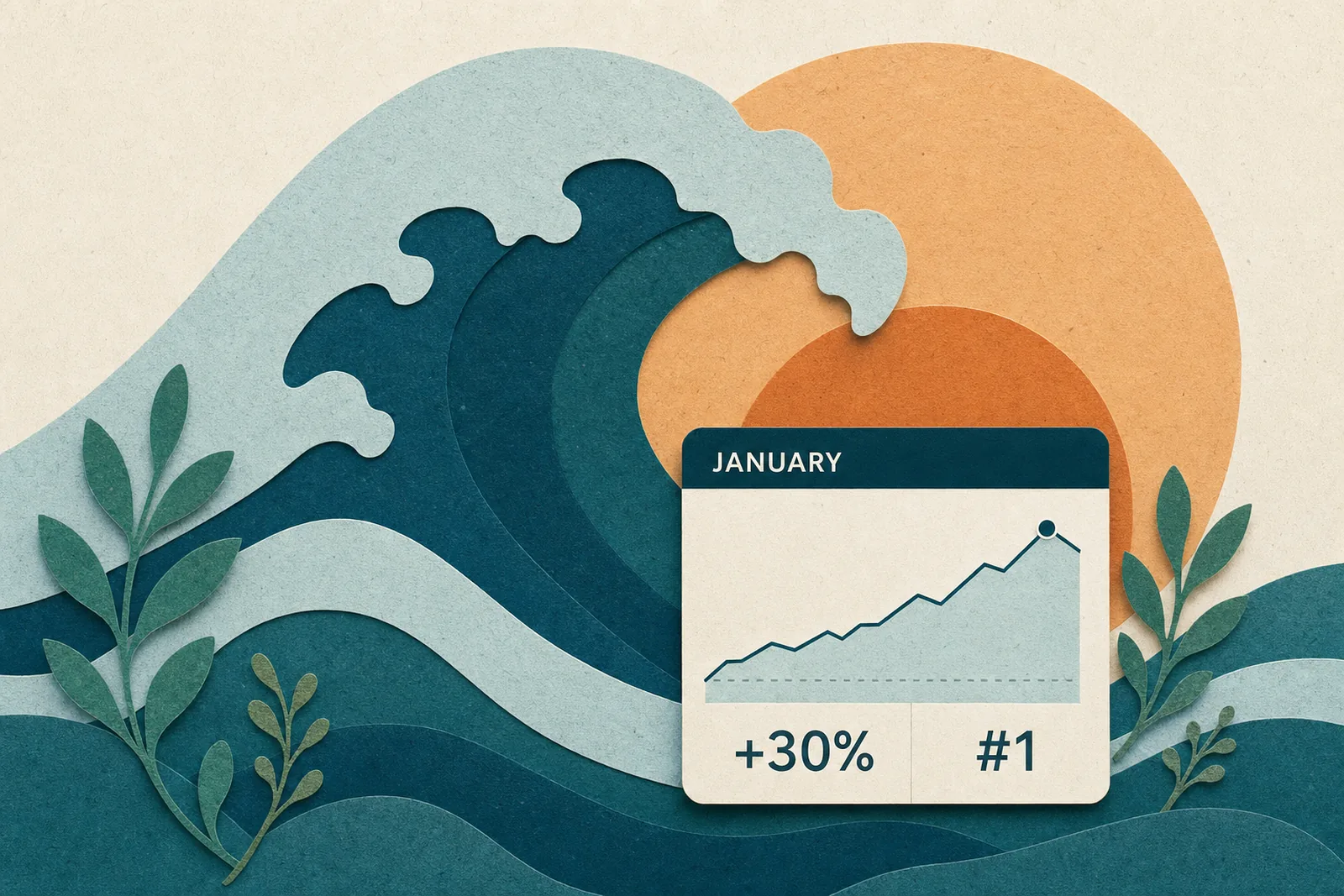

When do people look for therapists? Mostly in January. Search interest for terms like “therapist near me” and “anxiety therapist” climbs sharply in the first two weeks of the year, runs well above average through late winter, dips over the summer, and spikes again in September. This is one of the most predictable patterns in local search, and almost no private practice plans around it. Most therapists notice the January phone ringing, wonder what happened, and then forget about it by March.
I’m Patrick Antinozzi. I’ve spent 13 years running RapidWebLaunch and now run The Therapist SEO Company. This post lays out the actual seasonality of therapy demand, why it happens, and the part that matters for your business: rankings take months to build, so the practices that win January are the ones that invested the previous summer. If you read this in June and act on it, you’re early. If you read it in December, you’re planning for next year, and that’s fine too.
The shape of the year: when people actually search for therapy
You can verify all of this yourself in about five minutes with Google Trends (trends.google.com). Type in “therapist near me” or “find a therapist,” set the range to five years, and look at the shape. It repeats like a heartbeat:
| Period | What happens to therapy searches | Why |
|---|---|---|
| Jan 1 to mid-Feb | The annual peak. Interest often runs 10 to 30 percent above the yearly average | Resolutions, post-holiday fallout, new deductibles, dark short days |
| Mid-Feb to May | Elevated but declining. Steady inquiry flow | Momentum from January, spring stress (taxes, school pressure) |
| June to August | The annual trough | Vacations, looser routines, deferred decisions |
| September to mid-Oct | Second wave, smaller than January | Back to school, return to routine, “the year is almost over” reckoning |
| Late Oct to Thanksgiving | Quiet-ish | People white-knuckle through the holidays |
| Post-Thanksgiving and post-New Year’s | Sharp short spikes | Family gatherings surface what people were avoiding |
A few honest caveats before we go further. These are directional patterns, not laws. The exact size of the January bump varies by market, by specialty, and by year. Crisis-driven searches (“emergency,” acute symptoms) are far less seasonal than decision-driven searches (“therapist near me,” “couples counseling [city]”). And a practice with a strong referral pipeline will feel these waves less than one that depends on search. But the overall shape is remarkably consistent, and it’s the decision-driven searches (the ones that become long-term clients) that swing the most.
Why January is the biggest month for finding a therapist
Four things collide in the first week of January, and each one on its own would move the needle.
Resolutions. “Take care of my mental health” now shows up on New Year resolution lists alongside exercise and finances. Pew Research and others have documented how common health-related resolutions are, and therapy is increasingly how people act on the mental-health version. The person who spent November thinking “I should talk to someone” opens a search tab on January 3rd.
The holidays themselves. Extended family time is a stress test. Old conflicts resurface, grief gets sharper around traditions, marriages strain under the logistics, and people drink more. A lot of what surfaces between Thanksgiving and New Year’s Eve turns into a search in January.
Insurance resets. Deductibles reset on January 1 for most plans. People who put off care in November (“my deductible is almost met, but the year’s almost over”) start fresh, and open-enrollment changes mean thousands of people have new plans and are actively looking up which therapists work with them.
Winter. Shorter days and less light measurably affect mood for a meaningful share of people. Seasonal patterns of depression are well documented by organizations like the American Psychiatric Association, and January is the deepest part of that trough in most of the country.
None of these people woke up with a brand-new problem on January 1. They crossed a decision threshold. That distinction matters for your marketing: January is not when demand is created, it’s when existing demand converts into searches. Your job is to be standing in front of that conversion when it happens.

The September wave: back-to-school and the return to routine
The second seasonal event is smaller but very real, and it has a different character.
September searches skew toward families. School restarts and within three weeks parents are seeing the anxiety, the meltdowns, the grades slipping. Teachers start flagging concerns. Searches for child therapists, teen therapists, ADHD evaluation, and family counseling all firm up between Labor Day and mid-October.
Adults ride the same wave for a different reason. Summer is a socially acceptable excuse to defer everything. September ends the excuse. The stalled career, the marriage that limped through vacation season, the drinking that got worse instead of better: September is when “after the summer” arrives. There’s also a quiet “the year is two-thirds over” effect, a smaller cousin of the New Year reckoning.
If your practice serves kids, teens, or families, September may matter to you more than January does. Check your own numbers: if you were taking calls last September, count them. If you use our free therapy keywords tool, look at the child and teen therapy terms for your city. Those are the searches that spike when school starts, and a service page targeting them should be live and indexed by early August, not written in a panic on September 10th.
What seasonality means for SEO timing: build before the wave
Here’s the part that separates practices that profit from seasonality from practices that just observe it.
Google rankings take months to build. For a competitive local term like “therapist [your city],” a well-executed campaign typically needs 4 to 8 months to move a site from invisible to page one. Sometimes faster in small markets, sometimes slower in big ones, but months, not weeks. That’s just how trust accumulates in search: content gets indexed, your Google Business Profile builds signals, links accrue, and Google slowly re-ranks you against practices that have been there for years.
Now put that timeline against the demand calendar:
| When you start SEO | Where you likely are in January | Result |
|---|---|---|
| June to August | Ranking, or close to it | You catch the full surge |
| September to October | Climbing, partial visibility | You catch the tail and all of spring |
| December to January | Just getting indexed | The wave passes over you; you rank in time for the summer trough |
That third row is the expensive mistake, and it’s the most common one. Every January we get inquiries from therapists who watched the surge go to competitors and want to fix it right now. I have to tell them the honest thing: we can absolutely fix it, but the client flow shows up in spring and summer, and the first January they’ll fully capture is the next one. SEO rewards the people who moved before they felt the pain.
The flip side is genuinely good news: summer, the slowest season for therapy searches, is the best season to invest. Your competitors are coasting. Your own schedule is lighter, so you actually have time for the onboarding questions, the photo, the approvals. And every week of the quiet season is a week of ranking momentum banked before December. Our therapist SEO service runs the same playbook year-round, but the clients who start in June consistently have the best first January.
This is exactly how it played out for Dakota Trauma Therapy in Bismarck, ND. The work compounded month over month until the practice hit #1 for “bismarck therapists” with 21 local searches ranking in the top 10. When the seasonal waves come through Bismarck now, they break on her site first. The full numbers are in the case study.

Capacity planning: get your practice ready for the surge
Ranking in January is only half the win. The other half is being able to say yes when the calls come. Some practical moves, in rough order of importance:
- Protect intake slots in January and September. If your caseload runs full at 25 sessions a week, deliberately hold 2 to 3 openings going into the first week of January. A full practice that can’t book a new client for six weeks loses the inquiry: surge searchers are in decision mode and will simply call the next practice on the list.
- Tighten your response time. Speed matters most when volume is highest. An inquiry answered within a few hours converts dramatically better than one answered in two days, and during a surge, slow responses don’t wait politely in a queue, they book elsewhere. If you can’t answer fast, that’s a systems problem worth solving before December (it’s a core part of our lead generation service).
- Update your profiles before Thanksgiving. Google Business Profile hours (especially holiday hours), current photos, accepted insurance, and whether you’re accepting new clients. Google’s own documentation at support.google.com/business is clear that complete, current profiles perform better, and January searchers filter hard on “accepting new clients.”
- Decide your waitlist policy in advance. If you do fill up, a warm, fast “here’s when I expect an opening, and here’s how I’ll hold your spot” keeps some of those clients. Improvising it in mid-January keeps almost none.
- For group practices: hire against the calendar. If you’re adding a clinician, having them credentialed and listed by December beats onboarding them in February, after the wave. The September wave is likewise a hiring deadline for anyone building out child and teen services.
One number makes all of this worth the effort. A new therapy client is worth roughly $2,000+ in lifetime value (about $150 a session across 15 or more sessions). If being properly ranked and properly staffed for the surge nets you even three extra clients in January, that’s roughly $6,000 in eventual revenue from one month of being ready. Our whole service costs $1,500 a month flat, month to month, no setup fees, so the seasonal math is not subtle.
Seasonal content: what to publish and when
You don’t need a complicated editorial calendar. You need a few pages that match what people search in each season, published early enough to rank. A simple annual rhythm:
Summer (June to August): build the foundation. This is when the heavy lifting happens: core service pages, city pages, your Google Business Profile, site speed. Seasonal content sits on top of this foundation; it can’t substitute for it.
Early fall (August): publish back-to-school content. “Signs your child might benefit from therapy,” “how to help an anxious teen start the school year,” a clear child-and-teen services page. These need to be indexed before Labor Day to catch September.
Late fall (October to November): publish holiday and New Year content. “Coping with family stress during the holidays,” “how to find a therapist,” “does insurance cover therapy” (deductible-reset searches are huge in January). Written in October, these pages have two-plus months to rank before the surge.
Winter and spring: capture and convert. With the seasonal pages live, your effort shifts to responsiveness, intake, and letting the evergreen work compound.
Two notes on doing this well. First, write for the practice owner’s market, not for a national audience: “holiday family stress counseling in [your city]” will bring you clients, while a generic national article brings you nothing. Use the therapy keywords tool to see which seasonal terms actually get searched in your area before you write. Second, a seasonal page is an asset, not a campaign. The article you publish this October ranks better next October, and better still the year after. That’s the core difference between SEO and ads: ads reset to zero every January 1, while content compounds.
What about ads during the surge?
Worth addressing, because January is when every therapist gets pitched on Google Ads. Yes, ads can buy you visibility during the peak. But three things are true at once: therapy-related clicks are expensive (WordStream’s benchmark research at wordstream.com regularly shows counseling among the pricier local categories, with clicks commonly costing $5 to $15 or more in competitive metros), January is when competition and therefore cost peaks, and the moment you stop paying, you vanish. Ads during a surge are renting the wave at the wave’s highest price.
I’m not anti-ads. As a short bridge while SEO builds, they can make sense. But if you’re choosing where a limited budget goes, the ranking you build once keeps catching every January and every September after it, free. The ad budget has to be re-spent every single time.
Time the work, not the worry
So, when do people look for therapists? January most of all, September second, with sharp little spikes after every major holiday and a long quiet trough each summer. The pattern is public, free to verify, and repeats every year.
The practices that win it don’t work harder in January. They work earlier. Rankings built in the summer catch the winter wave, back-to-school pages published in August catch September, and the whole system compounds while competitors re-learn the same lesson every New Year.
If you want to know whether your site is ready for the next surge, run our free Practice Visibility Report. In about a minute it scores your site and lists the fixes that matter most, so you can decide with real findings whether the summer build is worth it. No contracts either way.
Frequently asked questions
- What month do most people search for a therapist?
- January is the consistent peak. Google Trends data for terms like 'therapist near me' shows interest climbing in the first weeks of the year, often 10 to 30 percent above the annual average. New Year resolutions, post-holiday family stress, and fresh insurance deductibles all land at the same time.
- Is there a second busy season for therapy searches?
- Yes. September reliably brings a smaller second wave as school routines restart, parents notice their kids struggling, and adults return from summer to face stalled jobs and relationships. It is usually not as tall as January, but it lasts several weeks and skews toward child, teen, and family therapy searches.
- When should I start SEO to be ready for the January surge?
- Six months ahead, which means summer. New rankings for competitive local terms typically take 4 to 8 months to build. A campaign started in June or July has time to climb before December, while one started in January competes for a wave that is already breaking and mostly arrives in time for the spring slowdown.
- Do therapy searches slow down in summer?
- Generally yes. Search interest for therapy terms tends to dip in June, July, and August as routines loosen and people defer non-urgent decisions. That makes summer the cheapest, least competitive time to build: your site gets audited, rebuilt, and ranked while competitors coast, and you enter September and January already positioned.
Read more

Couples Counseling Marketing: Fill Your Caseload in 2026
Couples counseling marketing that works: the keywords couples actually search, the two-decision-maker dynamic, premarital niches, and Gottman/EFT signals.

Private Pay vs Insurance: Marketing Your Therapy Practice
How private pay vs insurance changes therapy practice marketing: what people search, how to rank for insurance-intent keywords, and how to transition safely.